Thou Shall Not Pass for Thou Art Scandrel!
Guide to Olde English
Jan 22, 2019 past ProofreadingPal in Writing Fiction
For whatever reason, sometimes you want to accept characters speak in that pseudo- biblical/Shakespearean English language of thee and thou and shalt. Before we become into the well-nigh popular of these words and a guide to using them correctly, allow'south brand one matter clear: no i ever actually spoke like this:
K fine art beautiful, like the sun and moon. I loveth thee with all
that is mine ain.
This is Modern English with some old-timey words thrown in. In fact, there is no such matter as "Olde English" in history. The language existence aped here is Early on Modern English (the English of the King James Bible scribes, Shakespeare, Milton, and the residue of the seventeenth-century-ish oversupply), but it'south actually inaccurate. Here's a bit of Milton'south original text of Paradise Lost:
So spake th' Apostate Angel, though in pain,
Vaunting aloud, but rackt with deep despare:
And him thus answer'd presently his bold Compeer
And a bit of the Male monarch James Bible, not revised:
And the world brought foorth grasse, and herbe yeelding seed
afterward his kinde, and the tree yeelding fruit, whose seed was in information technology
selfe, after his kinde: and God saw that it was practiced. (Gen. i:12)
It gets a scrap more modern when you update the spelling, just it's still not structured or punctuated in the language nosotros speak now.
And then, yes, "Olde English" is all made up, merely the individual words themselves did exist in general conversation, and they do come with grammer rules.
Thou vs. Thee
You tin can't but throw these into a sentence. Mis for the subject of the judgement (along with I, we, and they), and thee is for the object (along with me, united states, and them).
Thousand complaineth constantly.
I will give thee a hiding.
Additionally, thy works similar grand, never like thee. So:
Thy shalt rue the day. (correct)
I volition give this to thy. (incorrect)
Thyn (Old English), thyne (Center English), and thine(current spelling) are all "your."
To thine own self be true. (correct)
Thine is the power over the state and sea. (correct)
I will see thine die. (incorrect)
Verbs and Their Wacky Endings
Chiliad shalt die.
The Lord giveth, and the Lord taketh away.
Thousand art a scoundrel.
Dost thousand honey me?
Doth thou love me?
In English's commencement centuries, spelling was pretty much all over the place. The language, later on all, is a commerce-driven amalgam of Latin, Greek, German, French, Castilian, Yiddish, and—who knows? Perchance there's some Martian in at that place as well. These various verb endings do non alter their definitions. Shalt and shall mean the exact same thing.
What'southward important with these is not the meaning but the tense. Shalt is in future tense. Giveth, doth, dost, and art are in nowadays tense.
Thus, the line from The Avengers is right: "Doth Mother know yous weareth her drapes?" Skillful on you, Tony Stark.
Unto
Ah, the good ol(d)e "Exercise unto others." Unto just means to.
Belov'd vs. Dearest
Now, this is a fun one. The ways information technology gets misused—well, it's pretty much always misused considering it's just relevant when you're worrying about poetic meter. The apostrophe is a pronunciation guide. Belov'dis ii syllables: be-loved. Beloved is (or used to be) three syllables: be-lov-ed. Let's become back to the Bard for a sit-in:
'tis a consummation
Devoutly to exist wish'd. To die, to sleep; (Hamlet 3.1)
All that "wish'd" matter is for is to make sure it's one syllable to fit the iambic (unstressed/stressed) pentameter (v iambs):
deVOUTly TO be WISH'D. to Dice, to SLEEP
Today, nosotros don't say "wish-ed," so "wish'd" serves no purpose even in verse.
Ye vs. The
This is also a fun ane. While ye was used all the fourth dimension for y'all (both every bit subject and as object), information technology was never, in fact, used for theuntil the Victorians idea information technology was cute to have signs that read Ye Olde-Timey Inn.
The mistake comes from what's called a thorn. Information technology's ane of those letters that didn't make it into Modernistic English. Old English, Old Norse, Gothic, and Icelandic use it basically for "thursday." It has a few shapes, many of them looking like a Y, just this is the idea:
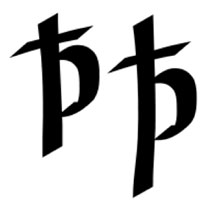
Mod keyboards type it as þ. When in one-time tapestries, paintings, and drawings there was a sign reading þ Old Inn, this was simply The Onetime Inn. Merely Victorians read information technology as Ye Old Inn.
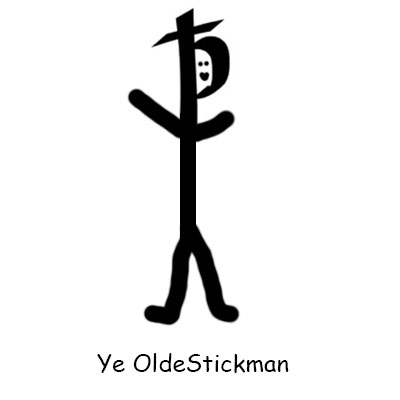
Then, while the crumpets and scones you get from Ye Olde Bake Shoppe may gustatory modality authentic, the sign is not.
Julia H.
0 Response to "Thou Shall Not Pass for Thou Art Scandrel!"
Post a Comment